- worldclass facility,pet films,stamping foils for you
- sales@chinabopetfilm.com

Heat Sealable PET Film: Structure, Technology, Benefits & Applications
Heat Sealable PET Film: Structure, Technology, Benefits & Applications
What is Heat Sealable PET Film?
Heat Sealable PET Film is a high-performance biaxially oriented polyester film (BOPET) engineered with a special heat sealable layer that enables direct sealing under heat and pressure without the need for adhesives.
By combining the strength and thermal stability of PET with low-temperature sealing capability, this film is widely used in food packaging, beverage containers, and lidding applications.
Origin of Heat Sealable PET Film Technology
Heat sealing technology originated with the development of thermoplastic polymers such as PET in the mid-20th century. As packaging industries evolved, traditional sealing methods (adhesives or mechanical sealing) were gradually replaced by thermal sealing systems.
With advancements in:
- Co-extrusion technology
- Multi-layer film design
- High-speed packaging equipment
Heat sealable PET film has become a key material in modern packaging, especially for food safety and high-efficiency production.
Manufacturing Process of Heat Sealable PET Film
The production of heat sealable PET film is similar to standard BOPET film but includes multi-layer co-extrusion technology.
Main Process Steps:
- Melt extrusion (single-layer or multi-layer co-extrusion)
- Casting (sheet formation)
- Longitudinal stretching (MD orientation)
- Transverse stretching (TD orientation)
- Heat setting
- Winding and slitting
This process ensures:
- High mechanical strength
- Excellent dimensional stability
- Superior thermal performance
Structure of Heat Sealable PET Film (A/B/C Design)
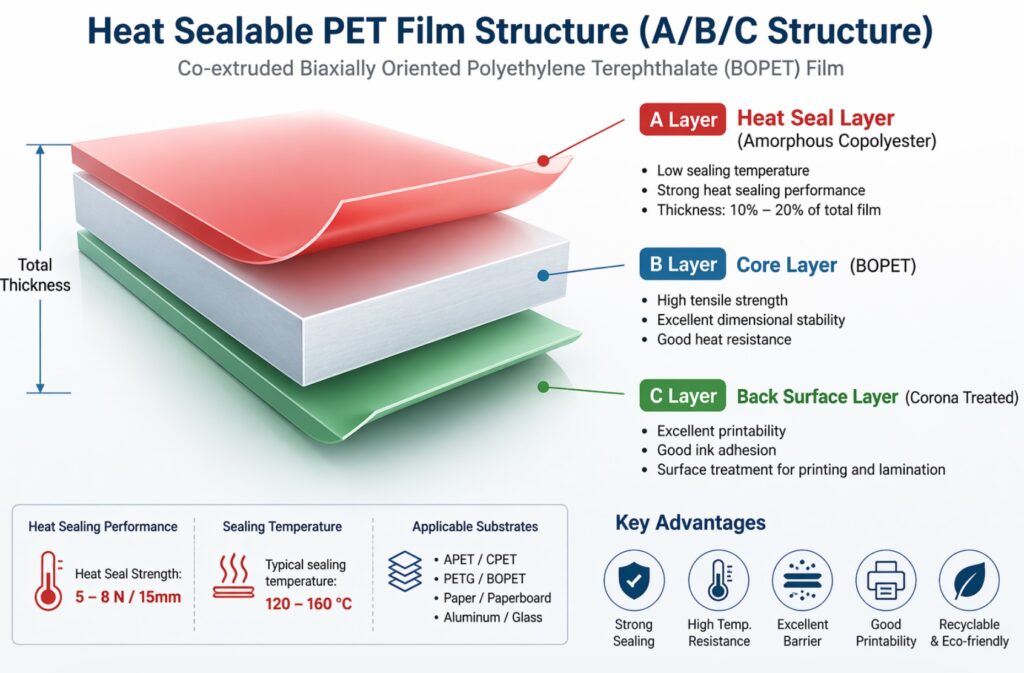
Heat sealable PET film is typically produced as a three-layer co-extruded structure (A/B/C structure):
A Layer – Heat Seal Layer
- Made from amorphous copolyester
- Acts as the heat sealable surface
- Thickness: 10%–20% of total film thickness
- Enables sealing at lower temperatures
B Layer – Core Layer
- Biaxially oriented PET (BOPET)
- Provides:
- Strength
- Rigidity
- Heat resistance
C Layer – Back Surface
- Usually corona treated
- Ensures:
- Excellent printability
- Good ink adhesion
Heat Seal Strength
- Typical range: 5 – 8 N / 15 mm
- Can be adjusted based on application requirements
Heat Sealing Principle
Heat sealing works through thermal activation of the seal layer:
- The heat seal layer softens or melts at a specific temperature
- Pressure brings surfaces into close contact
- Cooling solidifies the bond
Result:
A strong, uniform, and leak-proof seal formed by molecular bonding.
Why Use Heat Sealable PET Film?
✔ Reliable Sealing Performance
- Strong and consistent seals
- Excellent leak-proof capability
✔ High Temperature Resistance
- Suitable for freezer-to-oven applications
- Ideal for ready meals
✔ No Adhesives Required
- Cleaner process
- Safer for food packaging
✔ High Processing Efficiency
- Compatible with high-speed automatic packaging lines
✔ Wide Compatibility
- Can seal to:
- APET / CPET
- PETG
- BOPET
- Coated paper / paperboard
- Metal and glass
Key Benefits of Heat Sealable PET Film
Ideal for Food & Beverage Packaging
- heat sealable pet film for food can lidding and can body
- Maintains freshness and hygiene
- Prevents leakage in liquid packaging
Excellent Thermal Performance
- Resistant to high and low temperatures
- Suitable for microwave and oven use
Superior Printability
- Corona-treated surface
- Supports high-quality branding
Strong Mechanical Properties
- High tensile strength
- Excellent dimensional stability
Good Barrier Properties
- Aroma retention
- Moisture resistance
Sustainability & Environmental Advantages
Heat sealable PET film aligns with modern eco-friendly packaging trends:
1. Recyclable PET Structure
- Supports mono-material recycling systems
2. Reduced Material Consumption
- High strength allows thinner films
3. No Chemical Adhesives
- Cleaner recycling process
- Reduced environmental impact
4. Energy Efficiency
- Faster sealing = lower energy usage
Helps brands meet global sustainability regulations and ESG goals
Main Applications
Food Packaging
- CPET / APET tray lidding
- peelable anti fog heat sealable pet film
- Ready meals and frozen food
Beverage Packaging
- Aluminum laminiation for food can
- Tin plate lamination for food can
- Bottle and container lidding
- Dairy and liquid packaging
Industrial Applications
- Protective films
- FRP panel heat sealable film
- Aroma-sensitive product packaging
Conclusion
Heat Sealable PET Film is an advanced packaging material that integrates:
- Co-extrusion technology
- Multi-layer structure
- Efficient sealing performance
With its advantages in:
- Strength
- Heat resistance
- Seal reliability
- Sustainability
it has become a preferred solution for modern food and beverage packaging.
Get Technical Support & Samples
Looking for:
- Heat Sealable PET Film
- Lidding films for trays and containers
- Custom sealing solutions
Contact us for TDS, samples, and expert support